
Your Local Mortgage Lender
Located in Frisco, Texas
Personalized Mortgage Experience
TheLoanDesign offers personalized service and loan options you'll love. We shop multiple lenders to find the best rate and product for you, getting you into your dream home faster.
With wholesale interest rates and cutting-edge technology, we make the mortgage process seamless. Trust the experts who focus solely on mortgages. Support your local community and experience elite client service.
Let us help you achieve your homeownership dreams!
The Home Loan Process
Mortgage Pre-Approval
Get pre-approved from one of our Loan Officers to see how much you can afford.
Review The Process
Work with me to find your next home you would like to move into.
Loan Application
Complete your home loan application to get the lending process started.
Don't take my word for it
Mortgage Programs
Experience the best mortgage experience located in Frisco, Texas.
Home Loan Options
Our experienced mortgage advisors will walk you through the best mortgage loan program that will fit your specific scenario.
Conventional Home Loans.
FHA Home Loans.
USDA Home Loans.
VA Home Loans.
Frequently Asked Questions
How often can I refinance my mortgage?
There is no limit to the number of times you can refinance. However, you must qualify every time you apply and there will be costs associated with closing the loan each time.
Can I buy a home if I do not have money for a down payment?
Yes! There are a number of bond programs that offer low or no down payment financing options.
How do I know which mortgage is right for me?
The key to choosing the right mortgage is to understand the range of options and features available to you, as well as your budget, circumstances, and goals. Our licensed mortgage professionals are here to help you navigate that process. The more you know, the more comfortable and confident you will be choosing the best option for you and your family.
How long will the loan process take?
The Truth in Lending Act (TILA) does not permit a lender to close a loan until at least seven (7) business days have passed from the date your application was received. A typical home loan takes 30 days, as a number of third-party services such as appraisals, title work, and credit are required in conjunction with the mortgage process. Once you familiarize your Loan Officer with the details of your specific loan scenario, they will be able to provide you with a more specific timeline.
Will I qualify for a home loan?
The only way to find out is to speak with a qualified mortgage professional. Our Loan Officers have helped numerous clients who didn’t know if they could qualify to become home owners. We take the time to understand your financial situation and long-term financial goals, and then match you with the loan program that best fits your needs. Your approval for a loan may also largely depend on the price of the home you are financing. Getting pre-qualified prior to beginning your home search can give you an idea of what you may be able to afford.
Why do people refinance their mortgages?
Homeowners typically refinance to save money, either by obtaining a lower interest rate or by reducing the term of their loan. Refinancing is also a way to convert an adjustable loan to a fixed loan or to consolidate debts.
How much money will I have to pay upfront to buy a home?
This question does not have a simple, one-size-fits-all answer. The exact amount will depend on the price of the home you buy as well the type of mortgage financing you choose. Depending on your loan program, your down payment could be as much as 20% of the home’s price or as little as 3%, while some loans require no down payment at all.
Can I get a mortgage after bankruptcy?
You may still qualify for a home loan even if you have experienced a bankruptcy. The best way to find out if you qualify is to talk with a Loan Officer to discuss your options. Be sure to bring all paperwork regarding your bankruptcy so your Loan Officer can find the program that best fits your situation.
Should I lock my interest rate now, or wait until we are closer to our closing?
Interest rates fluctuate all day, every day. If an interest rate is good, it may be in your best interest to lock now. If you wait, you run the risk of an increase in rates later. If you are concerned that rates may go down after you lock, contact your Loan Officer to discuss your options. Some programs allow you to lock for an extended period and choose to lower your rate should a better one become available.
Most Recent Blog Updates
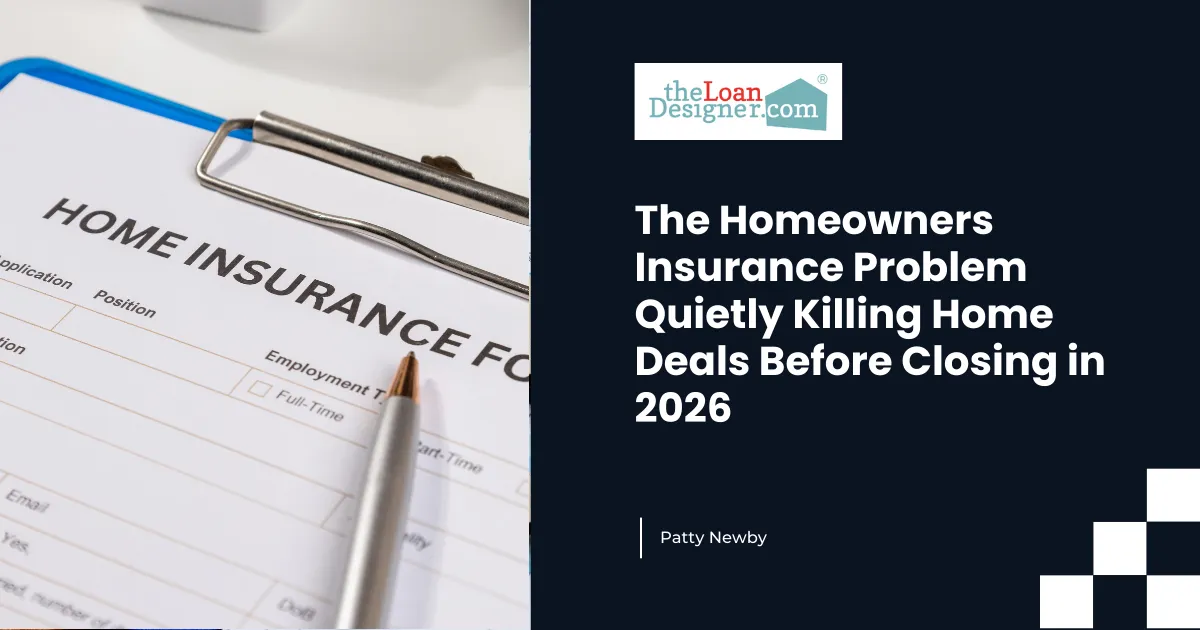
The Homeowners Insurance Problem Quietly Killing Home Deals Before Closing in 2026
The Homeowners Insurance Problem Quietly Killing Home Deals Before Closing in 2026
You Were Days Away From Closing. Then Everything Fell Apart.
You did the hard work. You searched, made offers, negotiated, cleared the inspection, and sailed through the appraisal. Your lender gave you the green light and closing day was on the calendar. The finish line was right there.
Then the deal collapsed.
Not because of anything with your loan. Not because of something the inspector flagged. Because of homeowners insurance. This scenario is playing out with increasing frequency in 2026 and it is blindsiding buyers who had no idea it was even a possibility. That needs to change before it happens to you.
Why Insurance Is No Longer a Simple Checkbox
For most of recent memory, homeowners insurance was the part of the closing process that nobody worried about. You called an agent, received a quote within a day or two, submitted the binder to your lender, and moved on. The cost was predictable, the coverage was available in virtually every market, and the whole thing was resolved quickly without complication.
That experience has become unreliable across a growing number of markets and property types. Insurance carriers have been pulling back from higher-risk areas, tightening their underwriting requirements, and repricing their exposure in ways that have sent premiums dramatically higher for certain properties and locations. Florida and California have drawn the loudest headlines, and the situation there is serious. In February 2026, Malibu made national news when the city filed legal action connected to wildfire damages, a development that underscored just how intense the risk and cost conversation in the insurance industry has become.
As Patty Newby explains, the reach of this problem has expanded well beyond the most visibly high-risk markets. More areas across the country are now feeling the effects as carriers reassess their exposure on a broader geographic scale and apply tighter standards in places they previously treated as routine. Buyers who assume insurance will be straightforward because they are not purchasing in California or Florida may be working from assumptions that no longer hold in today's market.
How a High Insurance Quote Destroys an Approved Loan
The mechanism by which insurance derails a closing is rooted in how mortgage approval actually works. When your lender approves your loan, that approval is based on your projected total monthly housing payment. That number includes your principal, interest, property taxes, and homeowners insurance premium all together. Every component factors into whether your debt-to-income ratio falls within the lender's acceptable threshold.
If the insurance quote that arrives near closing comes in significantly higher than the estimate used during the original approval process, your projected monthly payment increases. A higher monthly payment means a higher debt-to-income ratio. If that ratio now exceeds what the lender can approve, the loan that felt locked in is no longer valid under the same terms. A transaction that appeared certain can unravel within days with very limited room to recover on a compressed timeline.
The scenario becomes even more serious when a property cannot secure coverage at all. No homeowners insurance means no mortgage, without exception or room for negotiation. Lenders require an active policy as a firm and non-negotiable condition of closing. If coverage is unavailable or only obtainable at a premium that makes the debt-to-income ratio unworkable, the transaction simply cannot proceed regardless of how strong every other element of the file looks.
The Research Confirms This Is a Real and Growing Problem
This is not a collection of isolated anecdotes. Researchers studying the intersection of insurance markets and mortgage access have been documenting how rising premiums create a distinct category of barrier to homeownership that operates through debt-to-income limits rather than through credit quality or purchase price. What started as a concern concentrated in well-known risk areas has become a practical challenge that buyers, agents, and loan officers are navigating across a widening geography in real transactions every week.
The properties most exposed to this outcome are not limited to homes in visibly high-risk locations. Older homes, properties with aging roofs, homes with certain structural or mechanical characteristics, and properties in markets where major insurer exits have reduced competition and driven remaining premiums higher are all carrying elevated risk. An insurance surprise at closing does not require being located in a designated hazard zone to be financially devastating.
What Every Buyer Needs to Do Before Removing Contingencies
The most important shift buyers can make in today's environment is treating insurance as an early priority rather than a late-stage task. By the time you are removing contingencies and fully committing to the purchase, you need a firm quote from an actual carrier, not a ballpark estimate from an online tool or a general figure provided casually early in the process.
As Patty Newby advises her clients, the standard that actually protects a transaction is a real insurance quote from at least one carrier with a backup option already identified before contingencies are released. Some properties require surplus lines coverage or specialty policies that take considerably more time to secure than standard policies. Discovering that reality with only days remaining before closing leaves you with almost no good options and significant financial exposure if the deal unravels at that stage.
For any property with known risk characteristics, the insurance conversation should begin immediately after going under contract, not after the appraisal clears and certainly not in the final week before closing. The earlier you have firm numbers the more time you have to address any problems before they become crises with no workable solutions.
Make Insurance Part of Your Strategy From the Very Beginning
The buyers who avoid this problem are the ones who bring insurance into the conversation early and work with a loan officer who builds premium impact into the overall closing strategy from the start rather than treating it as a detail to handle at the end.
Patty Newby works with her clients to incorporate insurance timing and cost considerations into the closing plan from the beginning of the process so that nothing arrives as a surprise when options have run out. Reach out to Patty Newby to make sure your next transaction is fully protected from one of the most common and least visible deal-killers in today's housing market.
Sources
CNBC.com Forbes.com MortgageNewsDaily.com ConsumerFinancialProtectionBureau.gov InsurerNews.com

Mortgage Calculator
See your total mortgage payments using the tool below.
| Year | Interest | Principal | Balance |
|---|
Quick Loans
Blog
Programs
About Us
Social Media Links
YouTube
